
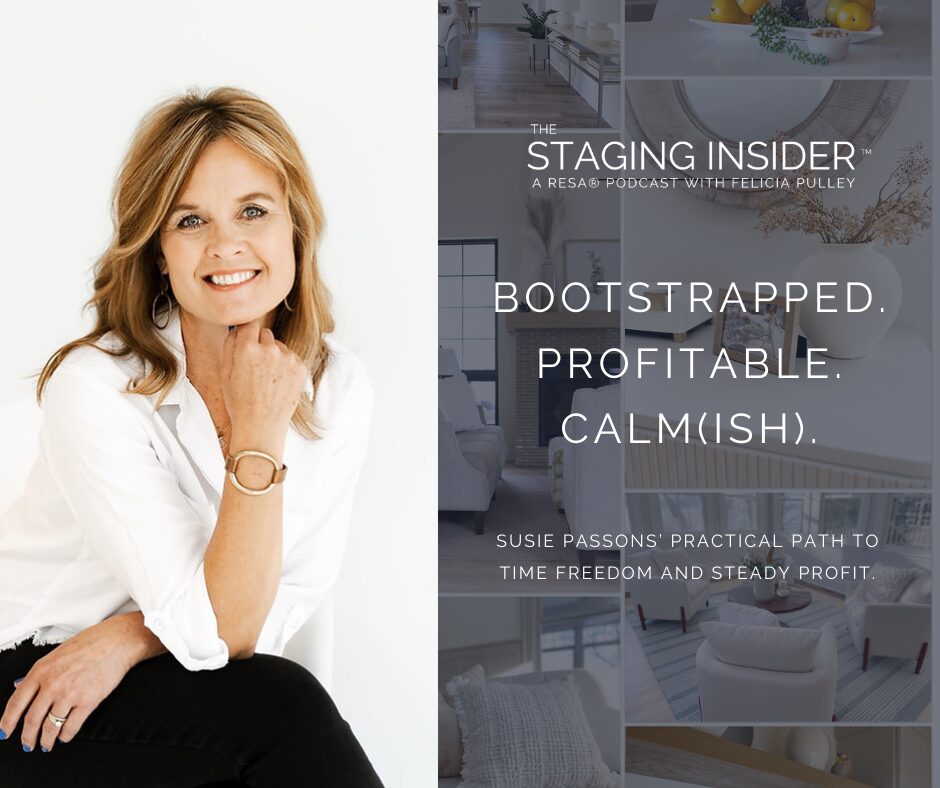
Some stories remind you exactly why this industry is so special. Susie Passons’ is one of them. From a Minnesota dairy farm to leading SP Design through growth, audits, and everyday wins, her path is a masterclass in steady, values-driven business building and the kind of real talk I love bringing to The Staging Insider.
From farm grit to photo-studio stylist
Susie’s work ethic was forged early, chores before school will do that. As she put it, “I grew up on a dairy farm in Minnesota, so work ethic and getting things done was instilled in me from the beginning.” Years later, she discovered her biological grandparents ran a furniture store and her dad works with high-end window treatments. That love of interiors? It really is in her DNA.
Professionally, she cut her teeth as an art director and photo stylist for a furniture retailer. Laying out ads, selecting palettes, styling sets. In her words, she was “essentially a stager within a photo studio,” long before she ever called it staging.
The leap (with a safety net she never used)
By her mid-40s, Susie knew corporate life wasn’t it. With agents in her circle and a knack for interiors, she started staging on the side—60–70-hour weeks while keeping her day job. She and her husband earmarked $6,000 “just in case,” but she never touched it: “I never ended up using that money, and instead used funds from stagings to start building an inventory. I never purchased more than the funds coming in.”
Her defining moment? Convincing a builder to let her stage a model for the Parade of Homes. She drove home exhausted and ecstatic, grateful for the chance—and hungry for the next one.
Learning to lead (and to breathe)
Like most of us, Susie wrestled with imposter syndrome and the sting of early client critiques. Today, she pauses before responding, avoids texting tough conversations, and uses thoughtful, pre-scripted language. Boundaries matter, too: she aims to keep weekends sacred and, over time, learned to truly step away on vacation. She also moved from piecemeal helpers to employees—a Lead Stager (2021) and a Stylist (2024). She still sets the creative direction and handles purchasing, but trusts her team to pack, install, and style. The result: more capacity, better balance, and a business that isn’t dependent on her being everywhere at once.
The audit that validated the structure
If you’ve ever hesitated about W-2s vs. 1099s, listen up. When Minnesota’s Unemployment Insurance division audited her, the preparation paid off: clean records, QuickBooks for books, Gusto for payroll, and employees on payroll. “Having QuickBooks and Gusto were super valuable in retrieving information like profit and loss [and] employee payroll information,” she told me, and that clarity made the process smooth and confidence-building.
Pricing, capacity, and the warehouse that changed the game
Susie raised her consult fee in November 2023, timed to a slower season—then did more consults the next year. She also invested in a warehouse to consolidate inventory (goodbye, scattered storage units) and hired professional movers who match her standards. Speaking on home-show stages gave her another confidence boost—and visibility.
What’s next
2025 is a growth year: scaling from ~60 to ~75 vacants, onboarding Stageforce, streamlining social with team help, and piloting a new service in Q3–Q4. On industry trends, she’s bullish on real-world staging—virtual has a place, but it won’t replace physical installs for agents who know the difference.
Takeaways for stagers (and why this story matters)
- Structure protects you. Employees, clean payroll, and accurate books aren’t “nice to have”—they’re risk management.
- Delegate with design guardrails. Keep purchasing and brand direction centralized; let trusted stylists execute.
- Raise prices with intention. Time increases to your market’s rhythms; track the outcome.
- Boundaries create longevity. Weekends off, real vacations, and systems that don’t hinge on you.
- Bootstrapping works—with discipline. Buy inventory from revenue, not hope.
- Community compounds growth. Local chapters, RESA®, conferences—this is where the practical, career-saving advice shows up.
Susie’s story isn’t flashy; it’s repeatable. It’s what happens when you pair farm-level grit with thoughtful decisions, a steady hand on the numbers, and the humility to keep learning. That’s the kind of success I want more stagers to see—and to model.
If this resonated, you’ll love the full conversation on The Staging Insider. Subscribe, share it with a stager who needs a nudge, and—if you’re building a team—consider this your sign to get payroll right and take that next step with confidence.

- Hutch Joins RESACON® as a First-Time Sponsor Bringing Business Software Built for Stagers - March 4, 2026
- How Operational Systems Help Scale a Home Staging Business: Why I Asked the Finessed Team to Lead This Conversation - March 3, 2026
- Record-Breaking Attendance at CREB: 121 Calgary Agents Attend RESA’s Staging to Sell Class - March 2, 2026

